01
Student systems
LMS, assessment, mentor CRM, support, aid, career
Pillar 3 / pre-employment architecture portfolio
A proven Unified Customer Object pattern mapped onto competency-based, personalized learning.
The bridge
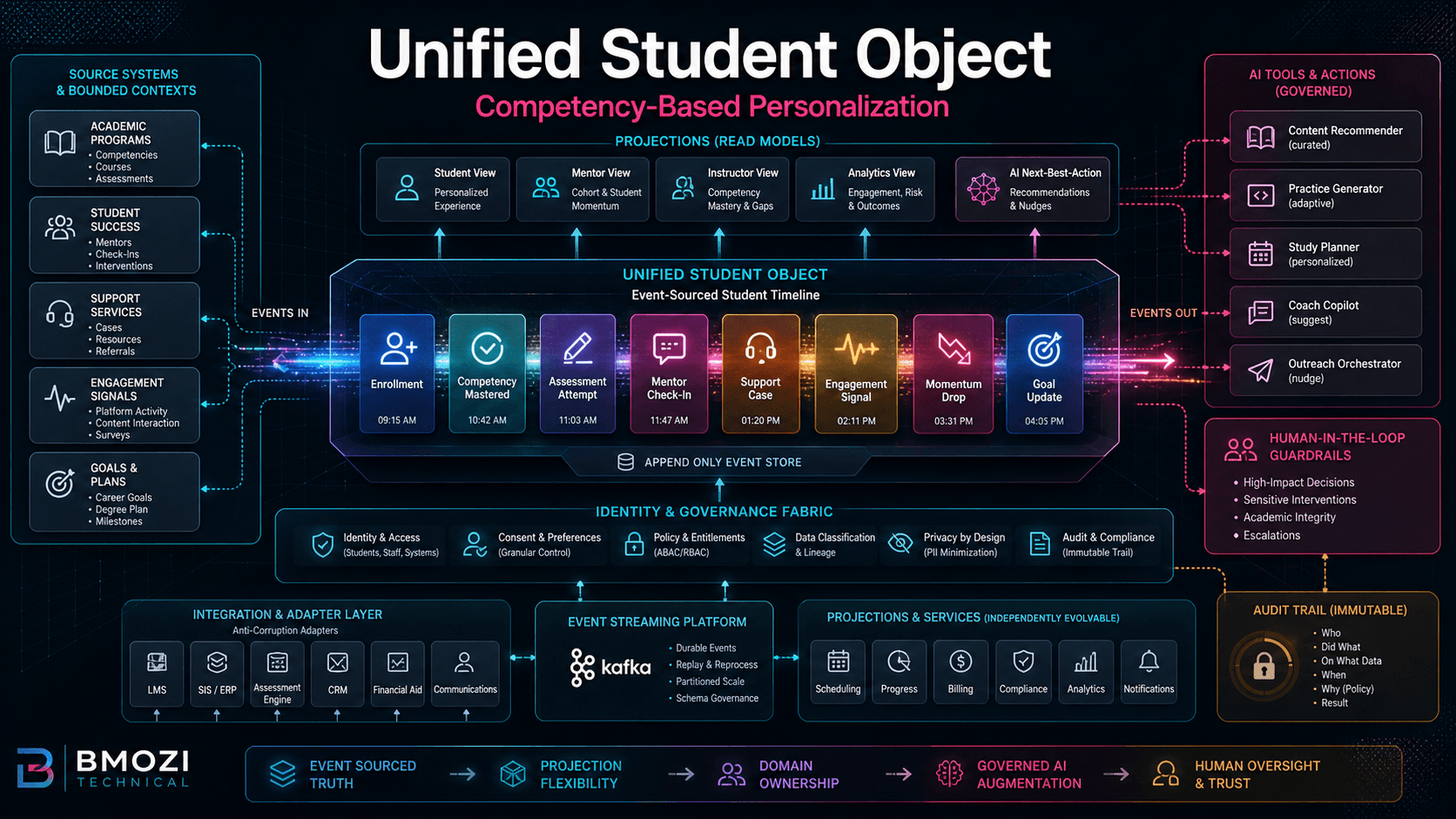
The GreenixOS UCO answers “what is the complete operational truth about this customer, and what should we do next?” A Unified Student Object answers the same for a student: learning progress, competency mastery, mentor interactions, support, engagement, goals, and risk.
The result is personalized pacing, proactive mentor outreach, and AI coaching, with human-in-the-loop control on anything high-impact.
UCO to USO mapping
The point is not a perfect schema. It is a domain model that starts from events, bounded contexts, and the jobs each role needs to do.
Event-driven shape
LMS, assessment, mentor CRM, support, aid, career
course.started, competency.mastered, assessment.evaluation.returned, mentor.checkin.completed, student.inactivity.detected, momentum.score.changed, career.goal.set
Append-only event store with per-student concurrency and replayable student history.
Student dashboard, mentor workspace, instructor blockers, risk queue, next-best-action, analytics warehouse.
Study plan, support outreach, assessment-readiness, AI assistant, mentor coaching prompts.
“Event storming is how I'd start the student-personalization work. Before anyone designs a schema, you put mentors, faculty, product, and engineering in a room and map the domain events on a timeline.”
Why event sourcing fits
How long stuck? Struggled before and recovered? Which interventions worked? Is this slowdown normal for a working adult? CRUD shows now; event sourcing preserves the story.
Student, mentor, instructor, evaluator, program leader, and AI experiences can each get the projection they need from one event stream.
Academic and support decisions need explainability; the event log is the evidence trail behind every recommendation.
Governed, permissioned projections and scoped tools keep AI useful without turning every student signal into raw prompt material.
Governance answer
“I wouldn't personalize by dumping every student signal into an LLM. The Unified Student Object exposes governed projections and scoped tools. AI assists mentors and students, but policy, permissions, audit, and human accountability stay in the platform.”
Role-based access by relationship to the student
Field-level permissions for sensitive data
Purpose limitation and consent where needed
Audit logs for data access and AI recommendations
Data minimization in AI prompts
Human-in-the-loop for high-impact decisions
Clear line between AI recommendation and official academic decision
Retention by data category
Mesh of meshes
Service mesh and data mesh are established. Agent mesh is emerging. The leadership move is to frame the forward vision, then immediately anchor it in concrete systems already built.
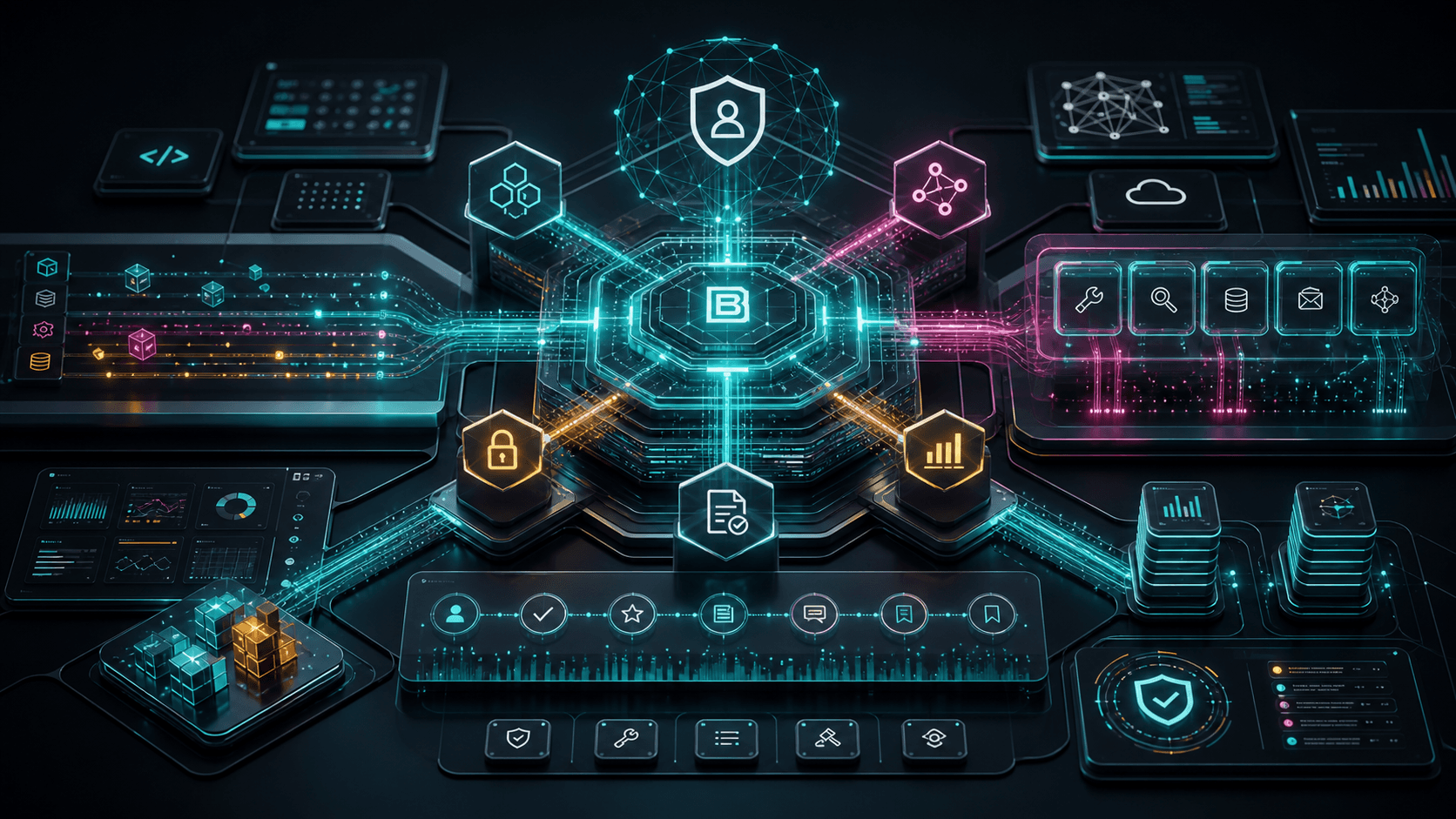
An early agent-mesh control plane: agents reach systems through scoped, audited tools, never raw credentials.
Domain-owned operational truth served as projections: UCO events, anti-corruption adapters, and independently evolvable read models.
Coordinated multi-agent work patterns with standards, review loops, and delivery discipline.
Interview-ready language
These are the concise explanations that connect the reference architecture to enterprise leadership, AI governance, and adoption.
30-second WGU application
The same UCO pattern maps directly to WGU as a Unified Student Object: an event-sourced student timeline projected into student, mentor, instructor, and analytics views, with governed AI for next-best-action and human-in-the-loop control on anything high-impact.
Sentinel MCP proof
Sentinel is the AI trust layer and owner of governed vendor integrations. Sentinel MCP exposes those capabilities to AI agents as scoped tools; agents never get vendor keys. Each tool call can become a durable governed command with policy validation, audit events, dead-letter handling, and replay.
Mesh of meshes vision
The enterprise is becoming a mesh of meshes: service mesh, data mesh, and the emerging agent mesh tied together by one governance and identity fabric. The vision is forward-looking; the receipts are Sentinel, GreenixOS, and Merlin.
Architecture communication
The architecture only survives if everyone understands it: up in ROI, OKRs, and risk; across through shared contracts and event storming; down through ADRs, diagrams, and mentoring.
Adoption strategy
Make the platform the path of least resistance first: paved roads, templates, real self-serve, one lighthouse team, measurable wins, and adapters that let teams move incrementally instead of through a big-bang rewrite.
Architecture talk track
Sentinel is the AI trust layer and owner of governed vendor integrations. MCP exposes those capabilities as scoped tools, so agents never get vendor keys.
A metadata-driven platform engine plus an event-sourced operational core. Vendors sit behind anti-corruption adapters with reconciliation.
Make the platform the path of least resistance: paved roads, self-serve templates, one lighthouse team, measurable wins, and incremental migration.
BMOZI Technical